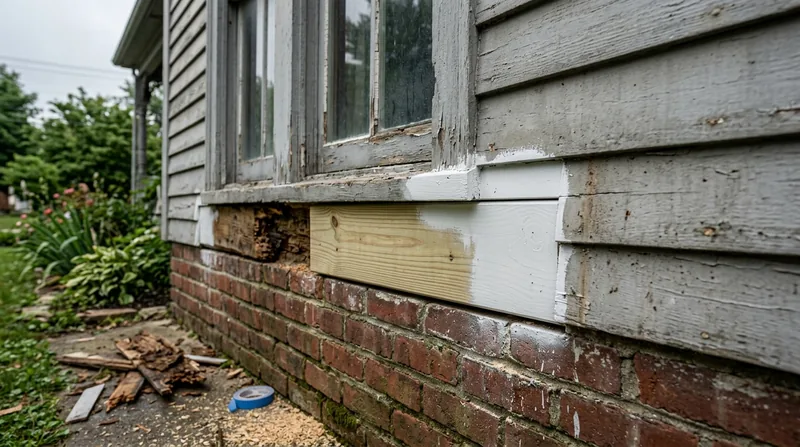




Fort Wayne's freeze-thaw winters, ice dams, and humid summers create ideal conditions for wood rot and dry rot repair in the city's Victorian mansions, 1920s bungalows, and Craftsman homes. The flat glacial terrain and proximity to the St. Joseph and St. Marys rivers mean older neighborhoods deal with damp basements, wet sill plates, and moisture-laden crawlspaces year-round. Water intrusion from ice dams on deep cornices, leaking fascia and soffit joints, and prolonged wet cycles in porch framing and exterior trim accelerate decay in Douglas fir and redwood lumber that has stood for a century. When wood rot takes hold in a load-bearing sill plate, floor joist, or structural beam, the repair is not cosmetic. We cut out the decayed wood, treat surrounding framing, and rebuild with rot-resistant lumber, delivering a permanent fix that restores strength and stops the spread. If you've noticed soft spots in a porch floor, dark staining on exterior trim, or a musty smell near the basement rim joist, contact us for a free estimate.
Why Wood Rot and Dry Rot Damage Accelerates in Fort Wayne's Climate
Fort Wayne sits at the confluence of two rivers on flat glacial till, and that geography drives moisture into homes from below and from above. Winter freeze-thaw cycles crack sealants and push water into fascia, soffits, and window sills. Spring and summer humidity keeps exterior wood damp for weeks after rain. Older homes with tall cornices, deep overhangs, and wood window frames concentrate water at the very places where rot starts: the junction of trim and siding, the base of porch posts, and the edges of roof overhangs where ice dams form.
- Ice dams trap meltwater against fascia and soffits, forcing water into the rim joist and exterior walls over days or weeks.
- Low crawlspaces and wet sill plates in older homes create standing moisture that softens wood fiber and feeds decay fungi.
- Porch framing, deck ledger boards, and exterior trim remain wet longer in Fort Wayne's humid summers, accelerating rot progression.
- Deferred maintenance on caulk, paint, and sealants exposes bare wood to rain and snowmelt, opening pathways for water and decay.
Addressing rot early, while the damage is still localized, saves the cost and complexity of replacing entire structural members later.
Key info: Fort Wayne's historic West Central and South Wayne neighborhoods feature Victorian and 1920s homes with wood-heavy exteriors and tall overhangs. These architectural details are beautiful and period-correct, but they trap water and accelerate rot in sill plates, fascia returns, and decorative trim. Early detection and repair preserve both the home's character and its structural integrity.
For detailed guidance on moisture issues and structural concerns, consult the City of Fort Wayne Building Department regarding permits for any work affecting load-bearing members or exterior walls.
How We Repair Wood Rot and Dry Rot: Step-by-Step Process in Fort Wayne
Our approach to wood rot repair starts with a careful inspection to identify the full extent of decay, the species of wood involved, and the source of moisture feeding the rot. We do not patch or cosmetically conceal damage. We cut out all compromised framing, treat the surrounding sound wood with a preservative, and rebuild the affected section with pressure-treated lumber or rot-resistant species appropriate to the location and exposure. The repair is built to last as long as the original framing.
- We inspect the affected area, probe soft spots to map the decay, and identify the moisture source (ice dam, leaking gutter, poor drainage, or high humidity).
- We remove all rotted wood back to sound framing, using hand tools and chisels to avoid damage to adjacent structure.
- We treat exposed sound wood with a wood preservative and allow it to dry before the next step.
- We measure and cut new lumber, matching the species and dimension of the original framing where possible, or upgrading to pressure-treated or naturally rot-resistant wood for exterior or high-moisture areas.
- We install the new wood, fastening it securely with galvanized or stainless fasteners and sealing all joints against water intrusion.
- We address the moisture source: resealing joints, repairing gutters, improving drainage, or ventilation as needed to prevent recurrence.
The result is a structurally sound repair that stops the rot and protects the home's framing for decades to come.
Example: A 1920s Craftsman bungalow in South Wayne developed rot in the rim joist and the base of a porch post where ice dams repeatedly forced water into the rim. We cut out 8 feet of compromised rim joist, treated the band board and header, installed new pressure-treated lumber, sealed all joints, and repaired the gutter and soffit joint to eliminate the ice dam pathway. The porch post was sistered with new framing bolted to the existing post, and the base was sealed. The repair took two days and cost less than replacing the entire porch structure.
Related structural work, such as floor joist and subfloor repair, often accompanies rot removal in older homes with wet crawlspaces or basements.
Wood Rot Repair Methods: Repair vs. Replacement
| Approach | Description | Best for |
|---|---|---|
| Localized rot removal and rebuild | Cut out decay, treat sound wood, install new lumber in the affected section only, seal joints and address moisture source. | Rot confined to fascia, soffit, trim, or a short section of rim joist or porch framing where the structural member is otherwise sound. |
| Sistering or reinforcement | Install a new structural member alongside the decayed one, bolted or lag-screwed to carry load while the original member remains in place or is partially replaced. | Rot in a porch post, floor joist, or beam where the decay is significant but the member is still in use and full replacement is costly or structurally complex. |
| Full member replacement | Remove the entire rotted framing member and install new lumber of the same or upgraded species and dimension, with proper fastening and load transfer. | Extensive rot affecting the majority of a beam, rim joist, or load-bearing wall, or when the member is undersized or no longer adequate for the load. |
| Moisture control and preventive sealing | Repair gutters, downspouts, and sealants, improve crawlspace ventilation, address drainage, and apply preservative to sound wood to slow future decay. | Early-stage rot or high-risk areas where moisture is the driver and the wood is still structurally adequate. |
Wood Rot and Dry Rot Repair Cost in Fort Wayne: What to Expect
The cost of wood rot repair in Fort Wayne depends on the location of the rot, the extent of decay, the structural member involved, and the source of moisture. A small area of rot in exterior trim or fascia may start at $650 and include removal, treatment, and rebuild. Larger jobs affecting rim joists, porch posts, or multiple structural areas can range from $1,500 to $5,000 or more. Load-bearing members or work that requires permits and engineering typically run higher and require an on-site inspection before pricing.
Several factors move the price up or down within these ranges. The species of wood matters: pressure-treated lumber costs less than naturally rot-resistant redwood or cedar. Access to the damaged area affects labor time; rot in a deep crawlspace or high porch soffit takes longer to repair than rot in an accessible rim joist. If the moisture source is complex (an ice dam, a failed gutter system, or poor drainage), addressing it adds cost but prevents the rot from returning. Permits and structural engineering, required for load-bearing work, add time and cost but ensure the repair meets code and carries the confidence of a licensed engineer.
We recommend getting two or three estimates from local carpenters so you can compare scope, materials, and timeline. A detailed estimate should itemize the labor, materials, and any moisture mitigation work, and it should clearly state whether the price includes permits or if permits are to be obtained separately. See our full pricing overview for more detail on how we structure estimates.
Wood Rot and Dry Rot Repair Near Me: What to Look for When Hiring a Carpenter in Fort Wayne
Choosing a carpenter for wood rot repair is not the same as hiring a general handyman. Rot repair involves structural diagnosis, moisture investigation, and the selection of materials and methods that will hold for decades. A good contractor will spend time understanding the source of the problem, not just cutting out the decay and moving on. When you are evaluating carpenters near Fort Wayne, ask these questions and verify their answers.
- Ask the contractor to explain the source of the moisture and how the repair will address it, not just remove the rot.
- Request references from recent rot repair jobs, preferably in homes similar to yours (age, style, and exposure).
- Confirm that the contractor is fully insured and can provide proof of coverage before work begins.
- Ask whether the job requires a permit and whether the contractor will obtain it or defer to you; structural work often requires a permit and a building department inspection.
- Get the estimate in writing, itemizing labor, materials, and any subcontracted work such as gutter repair or moisture control.
- Verify that the contractor has experience with Fort Wayne's older housing stock and the specific failure modes of Victorian, Craftsman, and 1920s homes.
If the rot is in a load-bearing member such as a beam, rim joist, or structural wall, ask whether the contractor recommends a structural engineer to size the replacement member and verify that the repair meets code. Do not assume that a repair is adequate without that confirmation. Contact us for a free estimate and we will walk you through the inspection, the options, and the cost before any work begins.
Wood Rot & Dry Rot Repair in Fort Wayne: Pricing Guide
| Service | Price | Details |
|---|---|---|
| Small rot repair (fascia, soffit, or trim) | Starting at $650 | Removal, treatment, and rebuild of localized decay in exterior trim or soffit, includes material and labor for one to two hours of work |
| Rim joist or porch framing rot repair | Starting at $1,500 | Removal of rotted rim joist or porch post base, treatment of sound framing, installation of new pressure-treated lumber, and moisture mitigation |
| Extensive structural rot or sistering work | Starting at $3,000 | Repair or replacement of multiple structural members, sistering of beams or posts, or work requiring temporary bracing and extended labor |
| Complex or load-bearing repair | On estimate | Beam replacement, full rim joist replacement, or work affecting load-bearing walls requires on-site inspection, structural engineer consultation, and permit |
| Travel | Included | No separate mileage charge or travel fee for Fort Wayne and surrounding Allen County service areas |
| Free estimate | No obligation | Response within 24 hours at (260) 300-5243, on-site inspection and detailed written estimate provided before any commitment |
Indicative pricing, the exact cost depends on square footage, finish, and site access. Free personalized estimate within 24h at (260) 300-5243.


