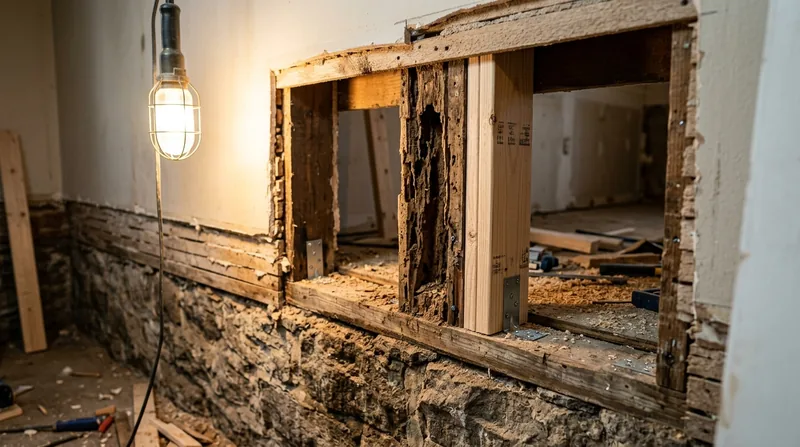




Termite Damage Repair in Fort Wayne starts after the exterminator finishes. Eastern subterranean termites and carpenter ants work quietly into the damp sill plates, rim joists, and basement framing that are common in Fort Wayne's older neighborhoods, particularly in the West Central historic district, Lakeside, and along the riverside areas where soil moisture is persistently high. The insects themselves are gone after treatment, but the galleries they've tunneled through the wood remain, weakening studs, joists, and trim that may look solid on the surface. We replace insect-damaged wood systematically, restoring full structural integrity and preventing further settlement or failure. This is not pest control, it is carpentry repair, and it happens on your timeline after you have a pest inspection report in hand.
Why Termite Damage Repair Matters in Fort Wayne: The Hidden Cost of Wet Basements and Old Framing
Fort Wayne sits on flat glacial till where the St. Joseph and St. Marys rivers meet, and that geography means damp basements, low crawlspaces, and wet sill plates in the older housing stock. Termites thrive in that moisture, and they enter through soil contact with wood framing. A sill plate that looks solid can be honeycombed inside, a joist rim can be soft enough to press your thumb through, and a basement stud can be load-bearing even as the insects hollow it out. By the time a homeowner notices sagging, soft spots, or mudtubes, the damage is often deep and structural.
- We identify which members are load-bearing and which can be replaced without temporary support.
- We remove damaged sections of sill plate, rim joist, floor joist, and subfloor, sistering new pressure-treated lumber where the existing wood justifies repair.
- We replace studs, trim, and porch framing that cannot be safely left in place.
- We work from your pest inspection report and coordinate with your exterminator's findings, not duplicating treatment or making health claims.
- We document the repair scope and materials for insurance claims if you choose to file.
Addressing termite damage promptly prevents secondary rot, mold growth, and the compounding cost of deferred structural repair.
Key info: Fort Wayne's freeze-thaw cycles and heavy spring runoff push water into basements and crawlspaces, creating the wet conditions termites and carpenter ants prefer. A home in Southwood Park or Wildwood Park with a damp fieldstone basement is at higher risk than a newer vinyl-sided ranch in Aboite, but older framing in any neighborhood can be vulnerable if moisture is present.
For permit and inspection requirements specific to your property, contact the City of Fort Wayne Building Department.
How We Repair Termite Damage: Step-by-Step Process for Fort Wayne Homes
Our approach is methodical and transparent. We start with your pest inspection report, identify which wood members are damaged and which are still sound, and then plan the repair scope. Load-bearing members like sill plates and floor joists often need temporary support during replacement. Trim, studs, and porch framing can usually be replaced without shoring. We work systematically, replacing damaged sections with pressure-treated lumber where moisture risk is high, and sound dimensional lumber where the repair is interior and protected. This is not wholesale replacement, it is targeted repair that restores the integrity you need.
- We inspect the damage site, measure the affected members, and confirm load-bearing status before removing anything.
- We install temporary support posts and beams if the repair affects floor joists, rim joists, or structural studs.
- We cut out the damaged section, leaving sound wood on both sides where possible to avoid unnecessary waste.
- We cut and fit replacement lumber to exact dimensions, using pressure-treated stock for sill plates, rim joists, and any below-grade members.
- We remove temporary support once the new wood is fastened and the repair is solid.
- We patch or refinish the area to match the surrounding finish if the repair is visible.
The entire process respects the integrity of the structure and the character of the home, whether it is a 1920s Craftsman bungalow in South Wayne or a Tudor Revival in Southwood Park.
Example: A home in Leo-Cedarville with termite damage to the rim joist and one floor joist in the basement typically requires temporary support, removal of the damaged sections, sistering of new pressure-treated lumber alongside the remaining sound joist, and fastening with structural bolts. The repair usually takes 2 to 4 days and costs between $2,400 and $4,200 depending on joist length and the number of connections. We also inspect the sill plate and any basement studs in the same area to catch secondary damage early.
For related structural carpentry and framing work, see our Framing and Structural Carpentry service page.
Repair Methods and When to Use Them
| Approach | Description | Best for |
|---|---|---|
| Sistering | Fastening new pressure-treated lumber alongside a damaged joist or stud, leaving the original member in place if sound on one edge. | Floor joists, rim joists, and basement studs where the damage is partial and one side is still load-bearing. |
| Section Replacement | Cutting out the damaged portion and splicing in new lumber with structural bolts or lag fasteners, leaving sound wood on both ends. | Sill plates, rim joists, and long members where the damage is localized and the ends are sound. |
| Full Member Replacement | Removing the entire joist, stud, or sill plate and installing new pressure-treated lumber with full-length fastening. | Heavily damaged joists, sill plates that are soft along their entire length, and structural studs where sistering is not feasible. |
| Porch and Trim Replacement | Replacing fascia, soffit, trim boards, and porch framing that are damaged by termites or carpenter ants, usually without temporary support. | Non-load-bearing exterior trim, porch stringers, railings, and fascia boards that are honeycombed or soft. |
Each method is selected based on the extent of damage, the load-bearing status of the member, and the best long-term outcome for your home. We explain the choice before we begin work.
Termite Damage Repair Cost in Fort Wayne: What to Expect
Termite damage repair in Fort Wayne typically starts at $1,200 for minor trim and joist damage and can range up to $6,000 or more for extensive sill plate replacement or multiple floor joists. The cost depends on how much wood is damaged, whether the members are load-bearing, the length of the repair, and whether temporary support is needed. A single damaged joist in a crawlspace costs less than a sill plate that runs 30 feet along the basement perimeter. Access matters too, a basement with a tight crawlspace costs more to work in than one with headroom. The materials themselves, pressure-treated lumber and fasteners, are modest, but the labor of careful removal, measurement, and installation is substantial.
We recommend getting 2 to 3 estimates from local carpenters who understand Fort Wayne's older housing stock and the specific pathology of termite damage. Each estimate should itemize the members to be replaced, the repair method, and the timeline. Insurance may cover some or all of the repair if the damage was caused by a covered peril, so document the scope before filing a claim. See our full pricing overview for more detail on how we structure estimates and what factors move the final cost.
Factors that affect termite damage repair cost:
- Number and length of damaged joists, sill plates, or studs in the repair scope.
- Load-bearing status of the member, which determines if temporary support is needed during replacement.
- Access and working space in the crawlspace or basement where the repair happens.
- Depth of damage, ranging from surface galleries to complete hollowing that requires full member replacement.
- Material grade, pressure-treated lumber for below-grade work costs more than standard dimensional lumber for interior studs.
Call us at (260) 300-5243 for a free, no-obligation estimate. We respond within 24 hours and will walk you through the cost drivers specific to your home.
Termite Damage Repair Near Me: What Fort Wayne Homeowners Should Know When Hiring a Carpenter
Finding the right carpenter for termite damage repair means looking for someone who understands structural repair, not just finish work, and who can explain the damage clearly without dramatizing it. A good contractor will ask to see your pest inspection report, identify which members are load-bearing, and explain why each piece is being repaired or replaced. They should be fully insured and able to provide references from previous termite and structural repair jobs. Many repairs in Fort Wayne require a permit if they involve altering a load-bearing wall or joist, so ask your contractor whether a permit is needed for your specific repair and who pulls it. Some homeowners associations, particularly in Wildwood Park and Southwood Park, have design review requirements for exterior work, so confirm that any fascia, soffit, or porch repair meets your HOA guidelines before you sign a contract.
- Verify that the contractor is fully insured and can provide proof of coverage before work begins.
- Ask for 2 to 3 references from recent termite or structural repair jobs, not just general carpentry work.
- Request an itemized estimate that lists each damaged member, the repair method, and the cost for each section.
- Confirm whether a permit is required for your specific repair and who is responsible for pulling it.
- Check with your HOA or local historic district office if your home is in a protected area like the West Central historic district.
- Ask how the contractor will coordinate with your exterminator and whether they will inspect for secondary damage in adjacent areas.
Taking time to choose the right contractor and understand the repair scope upfront prevents costly surprises and ensures the work is done right the first time. Contact us at (260) 300-5243 to request a free estimate, and we will help you understand your options and what the repair will cost for your home.
If your home also has wood rot or dry rot damage in addition to termite damage, we can assess and repair both in the same scope of work, addressing moisture issues and structural integrity together.
Termite Damage Repair in Fort Wayne: Pricing Guide
| Service | Price | Details |
|---|---|---|
| Single joist or stud repair | Starting at $1,200 | Sistering or partial replacement of one floor joist or basement stud, pressure-treated lumber, fasteners included |
| Sill plate or rim joist section | Starting at $2,400 | Replacement of 8 to 12 feet of sill plate or rim joist, may require temporary support, pressure-treated lumber throughout |
| Multiple joists or extensive damage | Starting at $4,200 | Two or more floor joists, basement studs, and porch framing in same area, temporary shoring, labor-intensive removal and replacement |
| Full sill plate or structural rebuild | On estimate | Complete sill plate replacement, extensive joist damage, or repairs affecting multiple structural members require on-site inspection first |
| Travel | Included | No separate mileage or call-out fee within Fort Wayne and surrounding service areas |
| Free estimate | No obligation | Response within 24 hours, detailed scope and cost breakdown provided before any work is scheduled |
Indicative pricing, the exact cost depends on square footage, finish, and site access. Free personalized estimate within 24h at (260) 300-5243.


